Working with Schools and Career Opportunities

There are so many career opportunities in Construction, now is the time to find one that matches your unique skill set. The industry offers lots of variety with small to large scale projects involving the Construction of anything from foot paths to whole towns and cities. All projects go through planning, designing, building and maintenance phases which may involve several different companies specialised in all different trades.

The industry employees over 2.7 million people in 2018 and has become one of the UK’s largest employers.

Try using the A-Z of Careers on the GO Construct website to do some research.  Not sure what role would suit you best? The personality quiz is a good place to start.  If you need any advice or help with careers in construction TVCTA are here to help, contact mail@tvcta.co.uk

An adult, seen from behind, in a 'DURKAN' branded safety vest and white hard hat, gesturing and speaking to a group of smiling and attentive students, who are all dressed in yellow hard hats and safety vests, on a sunny construction site.

Working with Schools

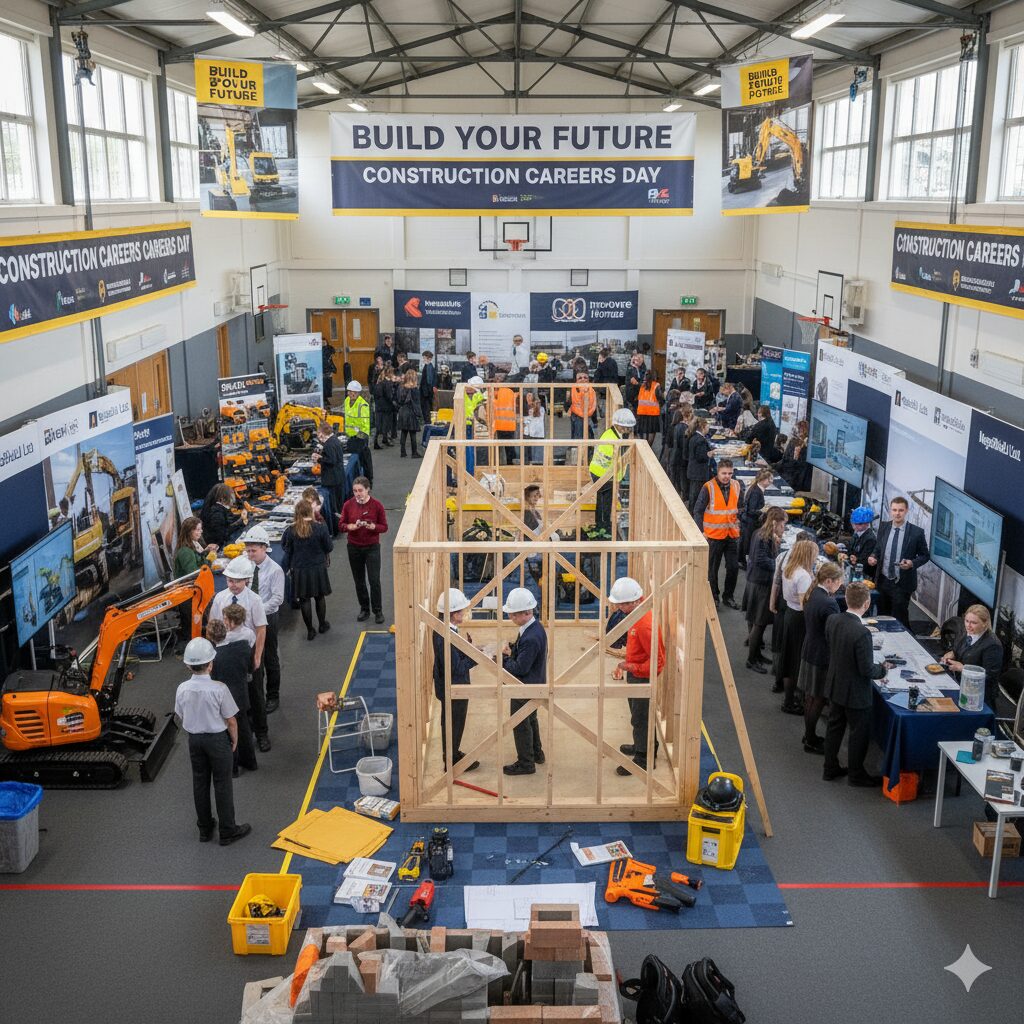
We support local schools and colleges by attending a variety of events such as Careers days or Mock Interviews to help promote Construction as a career.

Many of our members have taken on a student for on-site work experience opportunities, this helps them gain hands experience, training and get a feel for if it’s the right industry for them.  These are the kind of opportunities we would like more members to help us to promote a career in construction, if we can show them at this early stage of their lives what they can do and achieve, it will send a message that Construction is a Career for Life!

If you could help support our local schools and offer a few hours even once a year this would be extremely helpful and greatly appreciated by the schools and their students.  You would not need to do this alone, I could either attend with you or pair you with another member.  Its is great fun and would also help you tick a box when tendering for work or applying for accreditations.

We work very closely with Berkshire Careers Hub and The Skills and Business Hub based in Reading

A large school hall transformed into a 'Build Your Future' Construction Careers Day. Students in white hard hats engage with a wooden frame construction project, while others gather around booths featuring construction equipment like mini excavators, interactive displays, and industry professionals.

11 reasons why you should choose a career in construction

Whether you live in a small village, or a large busy city, you will never be too far away from a construction site at some point. Whether it’s a large-scale development employing hundreds of contractors, or small extension to a private house, construction is a major part of our everyday lives, and a visual representation of the amount of skilled trades required to support the industry.

1. There are many different routes into the industry

One of the huge appeals to a role within the construction industry is that there are many routes you can take, whether you are a school leaver, a graduate, or someone who has previously worked within a completely different sector, there are options for everyone! You just need to decide what route suits you best, whether it’s an apprenticeship scheme, studying for a degree, or applying for an entry level role and working your way up, with a little bit of research and guidance from Adele at AFC, you will soon be able to discover the best route for you!

2. Variety is the spice of life

The diversity of construction related career role options is huge, from administration right through to senior management positions, the opportunities are literally endless. There are roles to suit people from all different educational acumens, abilities, and previous career backgrounds, as well as roles suited to those with no prior experience or qualifications at all. Pick a role that appeals to you the most, a role where you can utilise your strengths and skills most effectively.

3. The sky’s the limit

The advantage of a career in construction is that your career aspirations can be as high and demanding as you choose, the only limit to what you are able to achieve is up to you! Whether you want to be in a managerial role or eventually run your own company, the opportunities are there within your reach, if you are willing to work hard to get there! Some of the highest earning professionals in construction companies started from the bottom and progressed through the extensive opportunities available.

4. Financial reward

An attraction to those working, or considering working within the construction industry, are the vast progression opportunities, and the associated chances to earn a healthy living. With current skills shortages being experienced within the construction industry demand is high for skilled workers, this has a positive knock on effect on those working within the industry. Companies are willing to pay competitive salaries to encourage hard working, talented and skilled workers to work for them.

5. Always in demand

As mentioned in the introduction, we are never too far away from a construction site. There will always be a demand for workers within the construction industry, whether you are looking for a contract role or a permanent one, you can rest assured you will always be in work. When one project ends, it is more than likely a new one is set to start with new opportunities, so with the skills gained from previous roles it shouldn’t be too difficult to find yourself a new and exciting challenge!

6. Teamwork makes the dream work

There are great opportunities to forge contacts, personal friendships and working relationships in construction, whilst pursuing your career. Whether you chose an office-based role or a site-based role, you will always be a valued member of a team, working alongside likeminded individuals and making your own personal impression. Together you will be working on creating and delivering projects you can look back on with a sense of accomplishment through teamwork

7. Amazing travel opportunities

If staying in one place or being confined to an office does not appeal to you, site-based roles provide various opportunities to travel. Depending on your lifestyle or family commitments, you literally have the option to go where the work takes you, wherever that may be.

8. Job satisfaction

A career within construction generally means that no two days are the same. You will be faced with new challenges, or a new project, every day. All construction projects evolve through the build process and at different stages of the construction phase plan. There is less chance of you becoming bored within this working environment, you are constantly stimulated as you may encounter new issues and problems to resolve. A lack of job stagnation can mean you are excited to go to work every day because you genuinely enjoy and embrace what you do, even if there are hurdles to overcome.

9. Personally rewarding

Aaron Hurst, author of ‘The Purpose Economy’ states that there are three types of purpose that most people are driven by, when it comes to their careers:

  • Personal Purpose – What drives you
  • Social Purpose -The feeling of belonging
  • Societal Purpose – Making a difference within society

A role in construction appeals to all three of these, so the job satisfaction you gain will be well worth it. Purpose centred individuals not only create more satisfying careers, but also contribute more to their own goals, their peers expectations, and their organisations values, so the knock on effect is a high level of positivity to all those you work with and affect by what you do. Whilst working on a project you are there to see it through from a conception on a piece of paper, through to completion. The sense of personal gratification you will experience when you can see the end project will make the whole process worthwhile and highly rewarding.

10. Making a difference

By pursuing a career in construction, you are making a big difference to your local community and even further afield! You can be involved in designing, planning and developing projects that can make a real difference too many people. Whether you are office based, working behind the scenes or working on site making these plans a reality you are helping create a better environment for all those benefitting by the projects you will be working on.

11. Continual personal development

There literally hundreds of different skill and competency training courses available to aid you in your personal development goals. These can be to help you increase your skills, or to prove your existing abilities through training and NVQ routes. Your continual development will result in you being a highly sought-after commodity, and help you to command the highest salaries and most rewarding career advancement opportunities

Its Not Just for the BOYS!

WOMEN IN CONSTRUCTION

Currently in the UK there are approximately 300,000 women working in construction.

Women in constuction.

Useful Links

Click on the links below to visit websites that offer advice and guidance on how to get started with a career in Construction.

Target Careers
TARGETcareers is here to help school leavers make decisions about their future. Explore options for careers, university or apprenticeships and get help applying successfully.

Go Construct
The Go Construct website showcases the many career opportunities available in construction and the built environment. It is funded by the CITB levy and led by the industry.

Future Made
A career in construction means living the life you want – and we’re here to tell you the stories of young people making it happen.

Herts Tools Co.

Has a trade career resource called  ‘How to get into construction’ and covers such areas as: roles and responsibilities, qualifications needed as well as salary and career progression information.


Podcasts

Here are a couple of podcasts that are worth giving a listen to hear from experts from the industry.

You Want To Do What?! 

Take Your Place – Apprenticeship Podcast Series

Civil Engineer

Job Role: Civil Engineers design, construct and maintain the buildings, burdges, dams, roads and other types of infrastructure that make up our cities and town. Part of their job role is to visit building sites and assess proposed plans to determine the environmental impact of large scale projects and whether the building materials will be sufficient to create a safe and stable structure.

Salary: Fully trained Civil Engineers can earn up to £60,000

Construction Manager

Job Role:  Construction Project managers co-ordinate and oversee development projects both onsite and in an administrative capacity. They work with planners and architects to estimate the cost of projects and amounts of materials required, plan the scheduling and construction procedures that will be undertaken and liaise with subcontractors to ensure projects run on time and to budget.

Salary: Fully trained project managers earn up to £60,000

Carpenter

Job Role: Carpenters are skilled manual workers who build and install structures made out of wood, wood-substitutes and other strong materials. As a carpenter you may be asked to work inside or outside on Construction sites, erecting the supporting frames for buildings, installing doors, ceilings, staricases and cabinets.

Salary: Fully trained Carpentaers can earn up to £30,000

Quantity Surveyor

Job Role: Quantity surveyors are responsible for managingall aspects of the contractual and financial side of construction projects. Surveyors work out exactly how much a building will cost to construct. They also calculate the amount of building materials that are required and are responsible for the finances of the project.

Salary: Newly trained Quantity Surveyors can earn in the region of £22,000 – £37,000. Senior or Chartered Quantity Surveyors can earn between £42,000 and £66,000

Architect

Job Role:  Architects design all kinds of buildings by drawing detailed plans or sometimes creating carboard or plastic models. They create detailed drawings for contractors that must contain exact measurements and building materials needed. As an architect you will working on all stages of the project carrying out inspection to make sure it meet requirements.

Salary: A Architect’s assistant or trainee could earn between £18,00 and £30,000. A Senior or Chartered Architect can earn in the region of £50,000 and £100,00

Estimator

Job Role: An estimator, also known as a cost planner or cost engineer, is responsible for calculating how much it will cost a supplier to provide a client with products or building work. They can be reponsible for drawing up bids for work, collecting quotes from suppliers and sub-contractors and keeping project costs in line with it’s budget.

Salary: Newly trained Estimators can earn between £18,000 and £20,000. Senior, chartered or Master Estimators can earn in the region of £35,000 – £40,000.

Construction Boot Camps

Construction Boot Camps can refer to short-term, intensive training programs designed to prepare participants for entry-level roles or specialized skills in the construction industry. These programs often combine hands-on experience, safety training, and job placement support — a great option for people wanting to quickly start a career in construction or upgrade their skills.

What Construction Boot Camps Offer

1. Duration:

  • Usually 4 to 12 weeks, full-time or part-time.
  • Some offer evening/weekend options for working adults.

2. Focus Areas

  • General Construction Skills: Tool use, materials, measurements, reading blueprints.
  • Safety Training: OSHA 10/30 certifications, first aid, fall protection.
  • Specializations (optional):  Carpentry, Electrical, Plumbing, Concrete or masonry, HVAC installation, Heavy equipment operation

3. Job Readiness

  • Resume building and interview prep
  • Networking with local contractors and unions
  • Direct job placement assistance

4. Certifications Often Included:

  • OSHA Safety Certificate
  • Forklift / Heavy Equipment Operator Card
  • NCCER Core Curriculum
  • First Aid / CPR

Who Benefits

  • Career changers wanting to move into the trades quickly
  • High school graduates seeking alternatives to college
  • Veterans using GI Bill benefits for trade training
  • Employers looking to upskill new workers

Cost and Funding

  • Range: Free to £7,000, depending on location and length
  • Funding sources may include: Workforce Innovation and Opportunity Act (WIOA) grants, State job training programs, GI Bill (for veterans), Employer sponsorships
Skills for life